When AI Gets Better at Being Human, I Want to Get Better at It Too
AI anxiety led me to a talk on whole-person education. A story about waiting and letting go showed me what no model can replicate—and brought me back to my daughter.
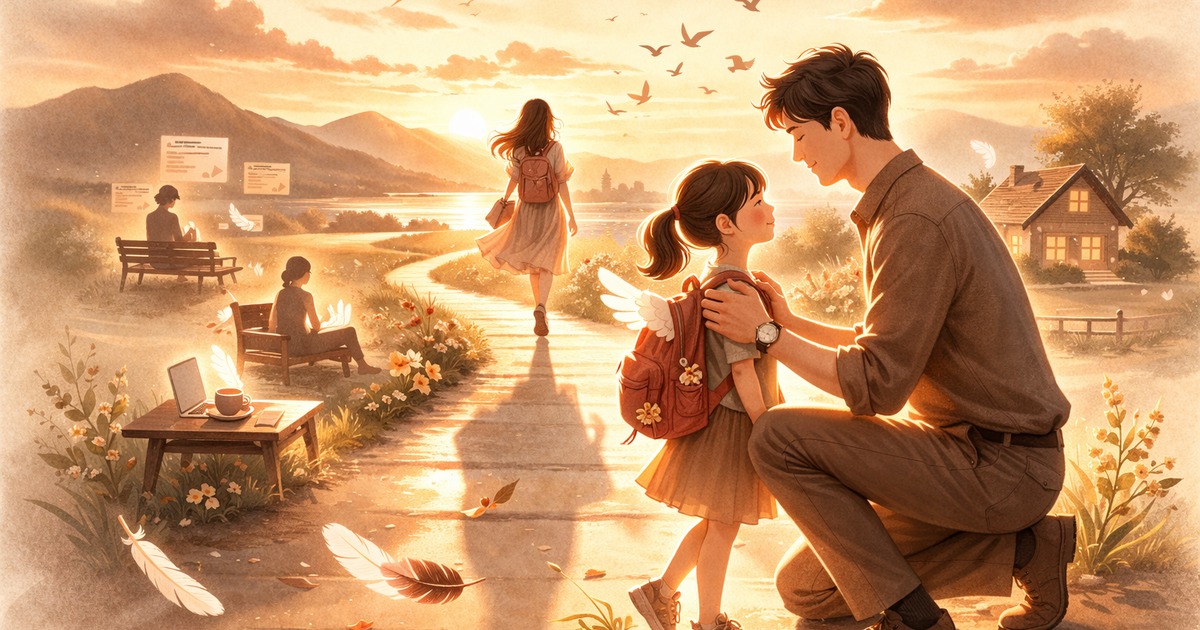
Fly well, Dad's always here
When AI Gets Better at Being Human, I Want to Get Better at It Too
flowchart TD
  classDef q fill:#eef2ff,stroke:#6366f1,color:#1e1b4b
  classDef ai fill:#f1f5f9,stroke:#94a3b8,color:#334155
  classDef turn fill:#fff7ed,stroke:#f59e0b,color:#78350f
  classDef key fill:#ecfdf5,stroke:#10b981,stroke-width:2px,color:#064e3b
  classDef land fill:#fdf4ff,stroke:#a855f7,stroke-width:2px,color:#3b0764

  Q["What's left for me?"]:::q

  subgraph LEFT["What AI does"]
    direction TB
    A1["Scale + pattern recognition"]:::ai
    A2["Recombine into new paths"]:::ai
    A3["But that's extrapolation"]:::ai
    A1 --> A2 --> A3
  end

  subgraph RIGHT["What AI can't"]
    direction TB
    H1["Weight of lived experience"]:::turn
    H2["Wait: you're not a problem to fix"]:::turn
    H3["Let go: you are you, not me"]:::turn
    H1 --> H2 --> H3
  end

  Q --> LEFT
  Q --> RIGHT

  A3 -->|"Life ≠ synthesis"| ANS
  H3 -->|"Let them be them"| ANS

  ANS["Live more fully human"]:::key

  ANS --> LAND["Fly well, home is here"]:::land
Notes after a talk on whole-person education
The question I couldn’t shake
For about half a year, one question kept circling back:
If AI can do a little bit of everything—and some things better than most people—what’s actually left for us?
I wasn’t looking for a comforting answer. I was genuinely unsettled. The more I watched AI improve, the harder it became to articulate what made the human part matter.
That’s the headspace I was in when I walked into a lecture on whole-person education. My reason was simple: I’d been telling myself that what AI can’t do is live more fully as a human. I wanted to see if anyone had a sharper way to say that.
What AI is—and what it isn’t
AI is extraordinarily good at organizing, synthesizing, and making answers sound polished.
Its power comes from scale: massive data, pattern recognition, recombination. It can take everything that already exists, rearrange it, and assemble paths nobody has walked. It can surface possibilities you’d never have seen on your own.
But that’s extrapolation—not wisdom.
It has no lived experience. It hasn’t endured anything. It hasn’t waited for someone it loves, or made the painful choice to let go.
And life doesn’t end at synthesis.
The most human—and least efficient—story I’ve heard
The speaker shared her turning point. She said her son becoming a monk was the greatest gift of her life.
She wasn’t Buddhist. Her son was a Stanford graduate. He didn’t ordain until he was 28.
But the heaviest part of the story is one word: wait.
He wanted to ordain for years. But he knew it would hurt his mother. So he waited—four, maybe five years. She didn’t understand, didn’t agree. He stayed.
By any modern standard, that’s absurdly inefficient. You know what you want. Just go do it.
But it’s precisely the inefficiency that makes it human.
The real turning point: at a dharma gathering, a fellow practitioner told his mother—your son prays before Guanyin nearly every day, asking her to let him go.
She heard that and something broke open. He was 28. It was his life. What was she blocking?
Sitting in the audience, two ideas clicked into place—and became my working definition of what “whole person” means:
- Waiting: I refuse to treat you as a problem I need to fix.
- Letting go: I accept that you are you—not my extension.
Not an answer—a direction
The anxiety didn’t disappear after the talk. But something settled.
- AI can synthesize brilliantly.
- But life’s endpoint is not synthesis.
- What humans need to practice goes beyond synthesis.
What we need to practice is how to live more fully as a human being.
This isn’t philosophy for me—it’s parenting
I keep coming back to my daughter.
How do I raise her so she lives like a whole person—not someone who only performs, complies, and optimizes? Someone who feels, thinks for herself, and connects honestly with others.
What I fear most is her learning too early to live as an “answer”—always right, always accommodating.
So when I heard you are you, I am me, I thought of her immediately. The best thing I can give her isn’t a paved road. It’s being there while she builds her own—and practicing the discipline of respecting that her struggles are her homework, not mine to fix.
She has her own rhythm, her own choices, her own life. Let her wings grow strong. Let her fly. Home will always be here.
One thing to hold
I went to that talk to protect a single conviction:
In an age where AI keeps getting more capable, I refuse to turn human life into a system to be optimized.
AI can help me move faster and organize better. But what I want to practice is what no model can:
How to live more fully as a human being.