Finding the Right Coach: A Stage-Based Approach
Use coaching in stages to fix what’s stuck—without turning it into a forever subscription.
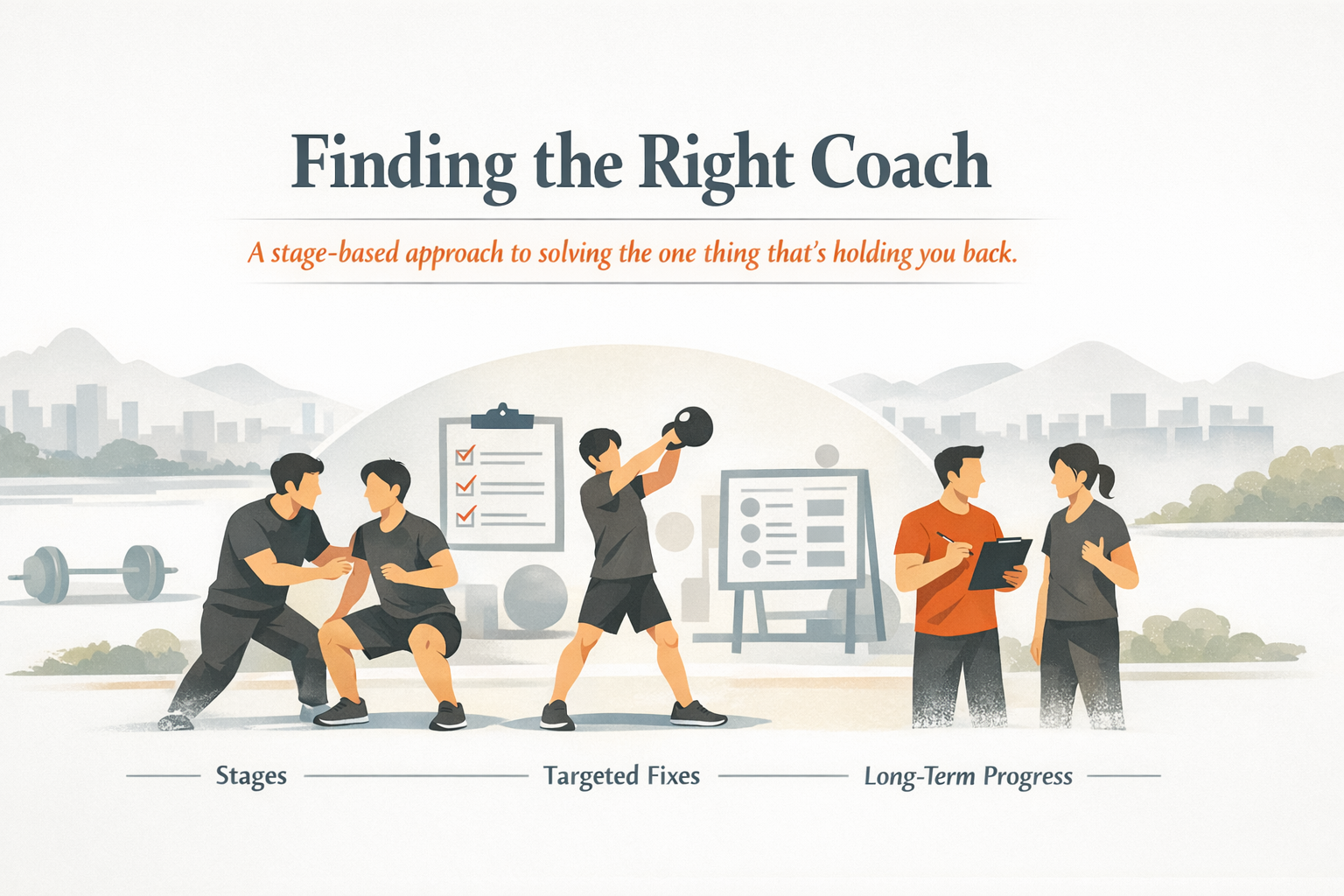
Finding the Right Coach: A Stage-Based Approach
flowchart TD
  classDef trap fill:#fee2e2,stroke:#ef4444,color:#7f1d1d
  classDef new fill:#ecfdf5,stroke:#10b981,stroke-width:2px,color:#064e3b
  classDef cycle fill:#eff6ff,stroke:#3b82f6,color:#1e3a5f
  classDef key fill:#fefce8,stroke:#eab308,stroke-width:2px,color:#713f12

  subgraph OLD["Two traps"]
    T1["Too expensive → delay"]:::trap
    T2["Already paying → keep going"]:::trap
  end

  OLD -.->|"reframe"| NEW["Coach = stage-based tool<br/>solve one stuck thing, then close"]:::new

  NEW --> CYCLE

  subgraph CYCLE["A practical rhythm"]
    direction TB
    C1["3 months: fundamentals + form"]:::cycle
    C2["2 months: internalize alone"]:::cycle
    C3["Stable: coach for programming"]:::cycle
    C4["Plateau: coach to break through"]:::cycle
    C1 --> C2 --> C3 --> C4
    C4 -.->|"next round"| C1
  end

  CYCLE --> KEY

  subgraph KEY["What makes it work"]
    K1["Know your need"]:::key
    K2["Match the style"]:::key
    K3["Give a clear instruction"]:::key
  end
I used to think hiring a coach was a binary decision:
Either you do it, or you don’t. And if you do, you commit—like you’re signing up for a long-term plan.
That mindset tends to push people into one of two traps:
- “It’s expensive” → you delay. You try to figure it out alone and keep repeating the same mistakes.
- “I’m paying” → you keep going. But the goal of each session gets fuzzy, and it turns into routine.
My current view is simpler:
A coach isn’t there to stay with you forever. A coach is there to remove the one thing that’s currently holding you back.
So I treat coaching as a stage-based tool, not a lifestyle subscription.
The rule: hire a coach with a clear job to do
Before I hire anyone, I try to answer one question:
What is the specific problem I want professional help to solve—right now?
If I can’t name it, I’m not ready to pay for coaching yet.
Stage 1: Start with a 3-month “intensive”
If you’re serious about training, my recommendation is straightforward:
Hire a coach early. Do it as a 3-month intensive.
- Frequency: 1–2 sessions per week is enough.
- Goal: get the foundations right before you accumulate bad patterns.
The hardest part about form is that you can’t see your own blind spots. Early correction saves time, frustration, and injuries later.
Stage 2+: Coaching is lifelong—but only in stages
I’m not saying you should work with a coach forever.
I’m saying this:
Coaching is a lifelong, stage-based task. Different stages require different kinds of help.
Here’s a rhythm that’s worked well for me:
A practical cycle (designed to “close the loop”)
- First 3 months: coach for fundamentals + form corrections
- Next 2 months: train alone to internalize the movements
- Once form is stable: coach for programming (how to build a plan)
- After 3–4 months on a plan: coach again to break a plateau
This keeps coaching high-signal: each phase has a clear purpose, and each phase can end cleanly.
The money question: you’re not buying sessions—you’re buying alignment
Yes, coaching costs money.
But I hold a blunt belief:
Pay for training now, or pay for healthcare later.
Training is a professional skill. You can read a few articles, but that won’t guarantee good form, good programming, or staying uninjured.
Coaching is simply paying for expertise—at the moments it matters most.
The real challenge isn’t “finding a coach.” It’s finding the right coach.
For me, three things matter.
1) Know what you need
Are you trying to:
- learn the basics?
- fix form blind spots?
- build unilateral strength?
- design a training plan?
- break through a plateau?
The clearer your need, the less likely you’ll be pulled into someone else’s agenda.
2) Match the communication style
Coaches vary.
- Some want to talk about lifestyle, diet, and everything around training.
- Some just run the session—minimal explanation.
Neither is wrong. But it might be wrong for you.
What I look for is simple:
someone who has read deeply, has a coherent training philosophy, and can think with me through decisions—not just tell me what to do.
3) Give a clear instruction
The value of coaching depends on your ability to be specific.
If you can’t give a clear instruction, you’ll get generic coaching.
A real example: 7 sessions, done
In early 2026, I had travel coming up—road trips and work trips. I didn’t want my training to break, and I couldn’t bring a full setup with me.
So I gave my coach a clear job:
Teach me how to train my whole body with a single kettlebell.
And I added two constraints:
- find and correct my form blind spots
- strengthen unilateral work
That’s it. No extra topics.
We solved it in seven sessions—cleanly. That’s my ideal coaching relationship: high clarity, high leverage, then done.
A short takeaway (for busy people)
If you ask me whether you should hire a coach: yes.
But don’t treat it as a forever commitment.
- Use coaching in stages
- hire for a specific problem
- match the communication style
- give a clear instruction
- end the phase when the job is done
Training isn’t a way to make a living. But it is the base your life runs on.
And the earlier you align the base, the easier everything becomes.